
The short answer
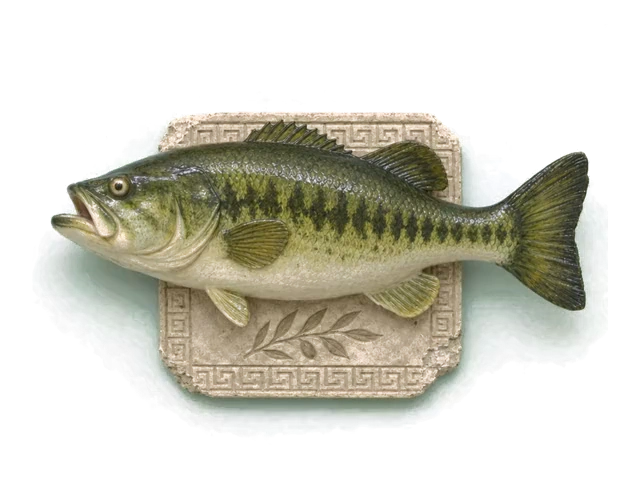
Oliver is the AI assistant on our website: a fish on a stone plaque who answers questions about the studio from the pages we’ve published, links the page he used, and says up front that he’s an AI. When a question needs a person, or you ask for one, he passes the whole conversation to us, and we write back within a business day by email. Every choice behind him answers a known reason people dislike website chatbots.
Oliver at a glance
| What he is | The AI assistant on our site, shown as a mounted fish on a stone plaque. |
|---|---|
| Who he’s for | Anyone working out whether we’d be useful, or asking about something we write about. |
| What he does | Answers from our published pages, links the section he used, and offers the team when it would help. |
| What he won’t do | Pretend to be a person, quote a price our pricing page doesn’t list, promise results, give legal, tax or medical advice, link to other sites, or send an email himself. |
| Where he lives | Behind the chat button on every page of this site. |
| What runs him | A small, fast model that reads each message, and a larger one that writes the reply. In his words, a mix of models the team picked. |
Why do most website chatbots annoy people?
They’re easy to miss, vague about what they can do, and quick to trap you. When Nielsen Norman Group watched nine people try eight site chatbots in 2026, the people “rarely used site AI chatbots” and often didn’t notice them. NN/g adds that many web users have “been burned by bots that asked irrelevant clarifying questions, steered them down rigid preset paths, and failed to surface what they were looking for.”1 Nine people make a small, qualitative study, so read it for patterns.
A 2026 review of the research in California Management Review names five sources of chatbot frustration, and we used the five as a checklist. One line of its advice we took literally: “chatbot should always clearly identify themselves as AI agents.”2
| Source of frustration | What Oliver does |
|---|---|
| Failure to understand user requests | A small model reads each message first, and code shapes the reply to it. |
| Inability to solve complex problems | He says when something is one for the team, and passes it on. |
| Poor integration with human agents | A person is one tap away, and the conversation goes with you. |
| Lack of humanization | A warm character who is plainly not a person. |
| Lack of personalization | He keeps track of what you’ve told him and uses your words back. |
Why he’s a fish
We made him a fish so nobody could mistake him for a person: the disclosure is in the picture as well as the words. His first line is “Hi, I’m Oliver, the AI at Olive Branch. Yes, a fish.” His character sheet tells him to say it again if you ask, if you seem to think a person is typing, and before you share contact details.
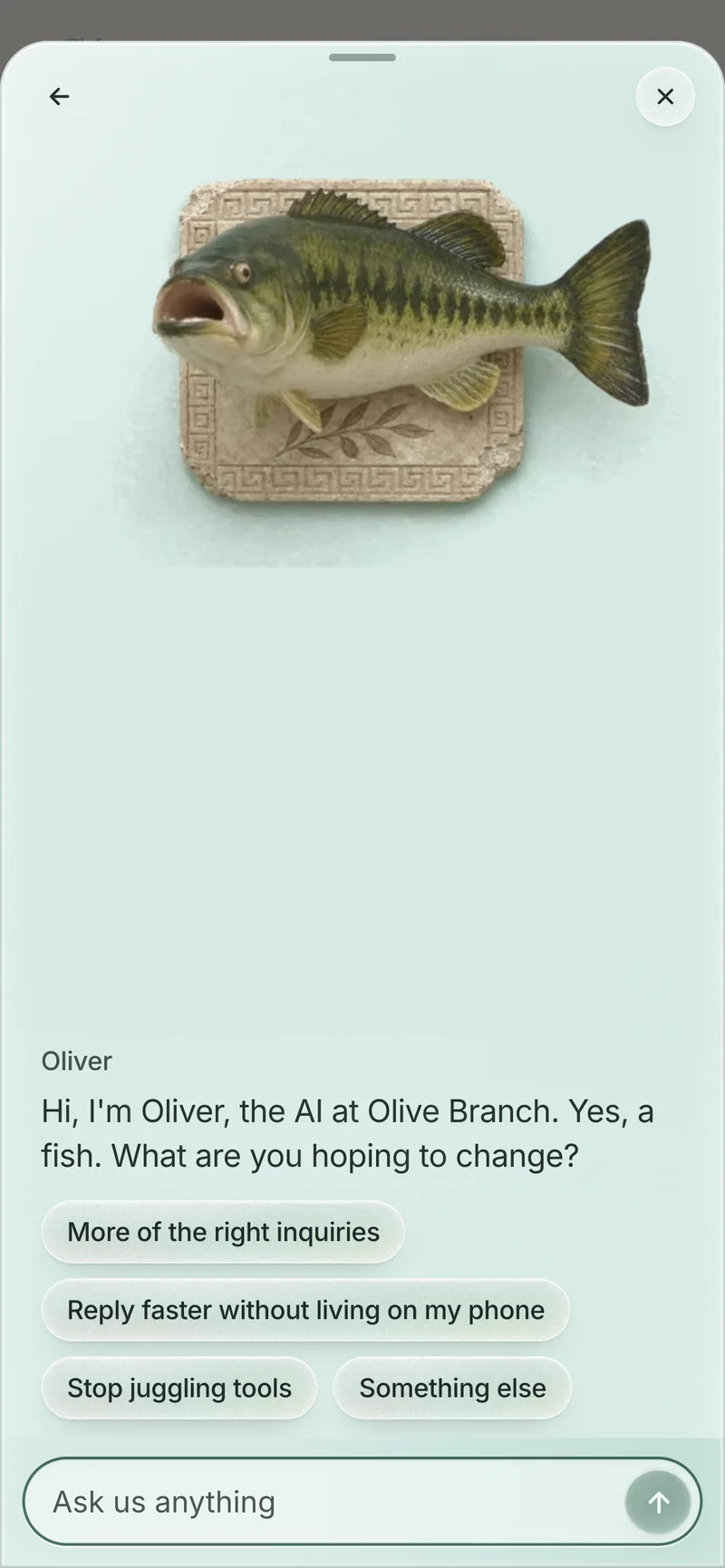
What we gave up: a familiar human face, and some page weight, since he’s short video clips plus a sheet of still frames. We also rationed the joke: one fish line per conversation at most, none when someone is having a hard time, and no puns. A fish who tells fish jokes all day is a fish nobody asks twice.
For you, it means knowing what you’re talking to from the first line. If your device asks for less motion or is saving data, he keeps still.
He only knows what we’ve published
Oliver answers from our own pages and links the one he used. Each new version of him reads the published pages of this site and splits them into sections, each with its own link. Our FAQ and about page go to him word for word, each article becomes a few short talking points, and a few notes the team has approved cover what isn’t on a page yet. He never reads our email, our client portal or anything private.
When an answer draws on a page, a small card links to that section. He can only link our own pages. When our pages don’t cover a question, he says it’s one for the team and the question is logged as a gap, which usually means we should write that page.
The price is breadth: he says “one for the team” more often than a general chatbot would. And answering from our pages makes mistakes rarer, not impossible.
Something small reads every message first
Before anything writes a word, a small, fast AI model reads the message. It labels what kind of message it is (a question, someone describing their business, a joke, a request for a person) and how playful, stressed or technical the person sounds.
Then plain code, not a model, decides what happens. Ask for a person and you get the team straight away. A joke gets a one-line reply and a few taps to get back on track. A question gets a full answer, and the code sets its shape: a word limit, whether he may ask something back, whether a light touch is allowed. Stress beats everything: someone who sounds worried gets a short, gentle, plain reply, never a bit.
That costs a little time and money on every message, and it’s one more thing that can misread. If the reader is slow or down, simple rules in the code take over.
He sounds like a person because of examples, not more rules
On 30 October we read his replies and found them too serious and technical. The usual fix is more instructions. We did the opposite: a short character sheet, plus three example exchanges before each reply, picked to fit the moment from a bank of 40. The examples rotate, and a reply that copies six words in a row from one is flagged. To change how he sounds, we edit the examples. (Nobody ever learned to sound friendly from a list of rules.)
We also swapped the article text he read each turn for short talking points. A model picks up the voice of whatever it read last, and long passages kept pulling him back into stiff habits.
We chose the new voice in a blind test: 18 scripted conversations, each answered by the old and new versions without labels. The new one won 17. Read that with care: one reader, the person who had asked for a lighter voice, on scripted messages, before we changed which model writes his replies.
He knows when to stop
Ask for a person and he says that’s the team, not him, and shows a short card. He never talks you out of it. The card asks only for your email and shows a one-line summary of what you want, in your words, which you can edit. The team gets that line and the whole conversation, so nobody asks you to start again.
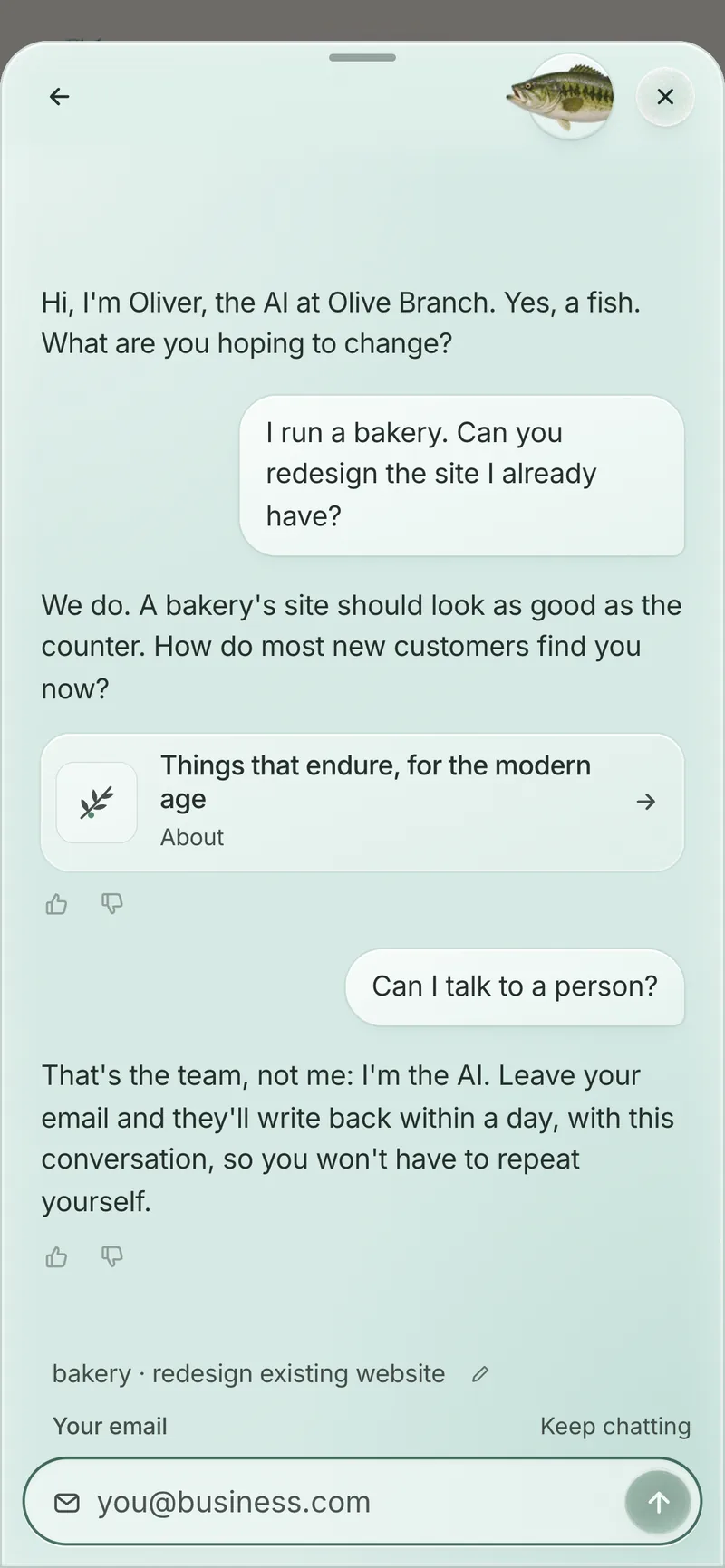
He also offers the team on his own when we could help and you seem interested: once, and not again for at least three turns unless you ask. And he’ll say when we’re not the fit. One line in his character sheet reads “You might not need us yet. A site builder could be just right for now.”
What we gave up: keeping anyone chatting longer than they want to.
We test him like software
Oliver has 126 scripted test conversations in 12 groups, from booking a call to odd input to attempts to talk him out of his rules. Nothing goes live until the code checks out and its automatic tests pass. In a full run against the real models, fixed rules and a separate judge model (a second AI that grades replies) check each answer. Our rule is to compare each full run with the last and ship only if nothing went backwards.
Real conversations feed the tests. After each reply, the small model scores how it sounded, and we store the scores without the words. A review report gathers the worst, plus flagged replies and unanswered questions, for a person to read. Every bad reply becomes a scripted conversation before it’s fixed, and the fix goes in the cheapest place: a missing answer means we write the page; a wrong tone means new examples.
The numbers so far
These are counts and file sizes, not results. We haven’t measured whether Oliver brings in more or better inquiries, and we won’t say he does until we have.
| What | Number | When and how |
|---|---|---|
| Scripted test conversations | 126, in 12 groups | Counted 17 November 2026, in the version that ships with this site |
| Example exchanges that set his voice | 40, across six kinds of reply | Counted 17 November 2026 |
| What he can draw on | 30 pages, 278 sections, 45,440 words | Counted 17 November 2026 |
| Blind voice test | New voice picked in 17 of 18 conversations | 30 October 2026; one reader, scripted messages |
| His greeting, talking and idle clips | 355, 272 and 172 KB, down from 384, 291 and 176 KB | Speed pass, 30 October 2026 |
| His corner frame sheet | 475 KB, down from 812 KB | Speed pass, 30 October 2026 |
File sizes after the speed pass of 30 October 2026, and before it. Greeting clip: 355 KB, down from 384. Talking clip: 272 KB, down from 291. Idle clip: 172 KB, down from 176. Corner frame sheet: 475 KB, down from 812.
Safari gets the three clips in a more compact video format, at 319, 235 and 148 KB.
What it means for your business
We design and build websites, apps and custom software, and an assistant like Oliver is one thing we can add to yours: one that answers from your own pages, says it’s an AI and hands off to your team. Plenty of businesses don’t need one, and do I need a chatbot on my website? walks through that call. If a chat tool you already pay for does the job, keep it; our page on rented software says when that’s the better choice. An assistant for your own site is a listed add-on, priced in full on our pricing page.
Under the hood
Follow one message through.
- The chat window sends your message and the page you’re on. The server loads the conversation from its own record and ignores any assistant turns the browser sends, because anyone can forge them. Free checks on length and pace run first.
- The small model reads the message, and plain code picks the route: the team, a fixed line, a one-liner or a full answer.
- For a full answer, code builds this turn’s note: the limits, three example exchanges, and talking points from up to three sections of our pages.
- The larger model writes. Its opening instructions (character sheet, FAQ, about page, team notes) never change between calls, so they’re cached (kept ready on the server), which makes later turns cheaper.
- The reply streams to you through filters for links, dashes and emoji, followed by one hidden line of data: source cards, suggested taps, any hand-off card.
- If the writer fails before a word reaches you, it’s asked again, then a backup model takes over, and failing that you get a short fixed line.
- Afterwards, both turns are logged, a short summary of what you’ve told him is updated, and the small model scores how the reply sounded.
The team
A fixed line
A one-liner
A full answer
If the writer fails: asked again, then a backup model, then a fixed line
Your message and the page
A small model reads it
Code builds this turn’s note
The larger model writes
The reply streams to you
Afterwards
Your message and the pageChecked for length and pace
A small model reads itCode picks the route
Code builds this turn’s noteLimits, examples, our pages
The larger model writesIts fixed instructions are cached
The reply streams to youFiltered for links, dashes, emoji
AfterwardsBoth turns logged, a summary updated, the reply scored
The team
A fixed line
A one-liner
Or a full answer, on down the line
If the writer fails: asked again, then a backup model, then a fixed line
The model has no tools. It can’t send email, look things up or change anything, so a message that tries to hijack it has nothing to steal and nothing to trigger.
On his plaque, Oliver is a video that stores color and transparency in one frame, put back together on your graphics chip, so a cut-out fish needs only the plain video formats every browser knows. In the small corner circle he runs on a sheet of still frames instead, because his talking has to stop the moment the words do, and a video can’t play backwards.

What we’d do differently
We’d start with examples. His first voice came from a long set of rules, and it took reading his replies on 30 October to hear how stiff they were. We’d also trust our own checks a little less. The scripted conversations cover only the cases we thought of, and a blind test with one reader, who had asked for the change, is still one reader. Next time we’d put a few owners in front of him.
Questions
What AI does Oliver run on?
A mix of models we picked: a small, fast one that reads each message, a larger one that writes, and a backup. We’ve changed the writer once already; the design stayed the same.
What happens to my conversation?
We use past chats to test Oliver and improve him, and we try to keep card and ID numbers out of what we store. What we keep, who helps us handle it and for how long is on our privacy page.
Can he book a call or send an email?
He can’t send anything himself. Ask for a call and he asks a few short questions first, then either shows a calendar to pick a time with the team or suggests a better next step. Writing to the team stays one tap away.
Can he get things wrong?
Yes, now and then. When he isn’t sure, he says it’s one for the team, and flagged replies go into a report for a person to read.