
The short answer
Choose by who will be there to reply. Live chat, a person typing back, is best when someone is at a desk and can answer within a minute or two. An AI assistant fits when questions arrive while nobody can answer, as long as it hands people to you. If you mostly want people to call, a tap-to-call number and a clear page beat both.
For many businesses the best fit is a mix: an assistant for the common questions, and a person for the rest.
How do live chat, a chatbot and a phone button compare?
| A person typing (live chat) | An AI assistant (chatbot) | A phone button and a clear page | |
|---|---|---|---|
| Who answers | You or your staff. | Software, from your own pages, then a person. | You, by phone. The page answers the rest. |
| When it works | Someone can reply within a minute or two. | Any hour, for questions with clear answers. | People would rather talk, and someone picks up or calls back. |
| What it needs from you each week | Someone watching the chat whenever it shows as open. | Reading the conversations and fixing wrong answers. | Keeping the page current and returning missed calls. |
| What it costs to run | Software bills per person who answers, per month: $19 per user on LiveChat’s Essential plan, billed annually.1 A staffed service bills per chat: $140 a month for 20 chats on Smith.ai’s Starter plan, then $7 a chat.2 | Some platforms bill per AI outcome, at most once a conversation, plus a seat for each person who takes over: $0.99 per outcome for Intercom’s Fin AI agent.3 | The phone line you already have. Answering services bill per call, per minute or per caller: see AI receptionists. |
| What goes wrong | Nobody’s there, so it becomes a slower contact form. | Wrong answers said with confidence, or a loop with no way to a person. | Calls go to voicemail and nobody calls back. |
The software is the cheap part. The hours someone spends watching, reading and fixing are what you’re really choosing between.
When does live chat win?
When someone can answer fast, live chat is the best of the three: a human, in the moment, without a phone call. It suits high-stakes questions, where a wrong answer costs more than a slow one, like a quote that depends on the details.
The best evidence comes from online retail. On Taobao, China’s leading consumer-to-consumer marketplace, women’s clothing sellers who offered live chat turned more of their visitors into buyers, and more so when their product pages said less.4 The sellers answered only about half the time; one of the authors told her university’s magazine that answering every time could raise conversion by 9 percent.5 A real effect, then, measured a long way from your front desk: it’s observational data on human sellers, the 9 percent is from an interview rather than the paper, and none of it is about service businesses.
The catch is the hours when nobody’s at the desk. The box still says “Chat with us.” The visitor types, waits and goes. In a Technion study of companies’ chat and messaging contact centers, 30% to 67% of customers who gave up waiting left silently, with no sign that they’d gone.6 An unanswered chat doesn’t look like a lost customer. It looks like a quiet afternoon.
When does an AI assistant win?
When questions arrive while nobody can answer, and they have clear answers: what you do, whether you take a job like theirs, how booking works. It replies at once, at any hour.
It’s only as good as what it’s been given and whoever reads its conversations. It can be wrong and sound sure, and it should never be the only way to reach you. The evidence and a checklist are in do I need a chatbot on my website?
When is a phone button better than both?
When people mostly want to talk to you, the questions are few, or nobody would watch a chat. Then you need a page that answers and a number that works:
- A number they can tap, at the top of every page on phones, as a real link (a picture of digits can’t be tapped).
- Your hours beside it, and what happens after hours: voicemail, a call back next morning, or a form.
- Your most common questions, answered on the page: where you work, how you quote, how soon you can start.
- A short form for people who’d rather not call, with a named person reading it.
Getting more inquiries from the site you have walks through these fixes. If missed calls are the real problem, look at AI receptionists instead of web chat.
What about an assistant that hands off to a person?
For most small businesses, this is the version we’d aim for: the assistant answers the common questions and passes the rest to a person. It only works if the hand-off lands somewhere. Gartner tells service leaders not to use AI “as a mandatory first step for every issue”, because customers forced through several failed AI exchanges before reaching a person are less likely to use the tool again.7
So before you switch one on, try to get past it to a person.
- Ask for a person in your first message. It should offer one at once, without making you ask three times.
- Read what it promises. A time you can keep (“we’ll reply tomorrow morning”), not “an agent will be with you shortly” at 9 p.m.
- Check it takes an email or a number and sends the conversation along, so nobody has to explain twice.
- Check a named person is told, by text or email. A shared inbox nobody opens doesn’t count.
- Try it at 10 p.m. on a Sunday, and see what happens next.
After that, the clock is yours. How fast to reply to an inquiry covers what good looks like.
Questions
Can I pay someone else to answer my live chat?
Yes. Staffed chat services answer for you, usually billed per chat. Ask what they say when they don’t know, how a new inquiry reaches you, and whether spam chats count toward your bill.
Can I run live chat only during business hours?
Yes, if the box changes when you leave. After hours it should say you’re away and when you’ll reply, or pass visitors to an assistant or a form. A chat that looks open but isn’t is the quiet failure above.
Is website chat the same as texting?
No. Chat usually ends when the visitor leaves your site; a text reaches their phone. A text link beside your number suits people who’d rather not call, but automated texts carry consent rules: see how fast to reply.
Where we come in
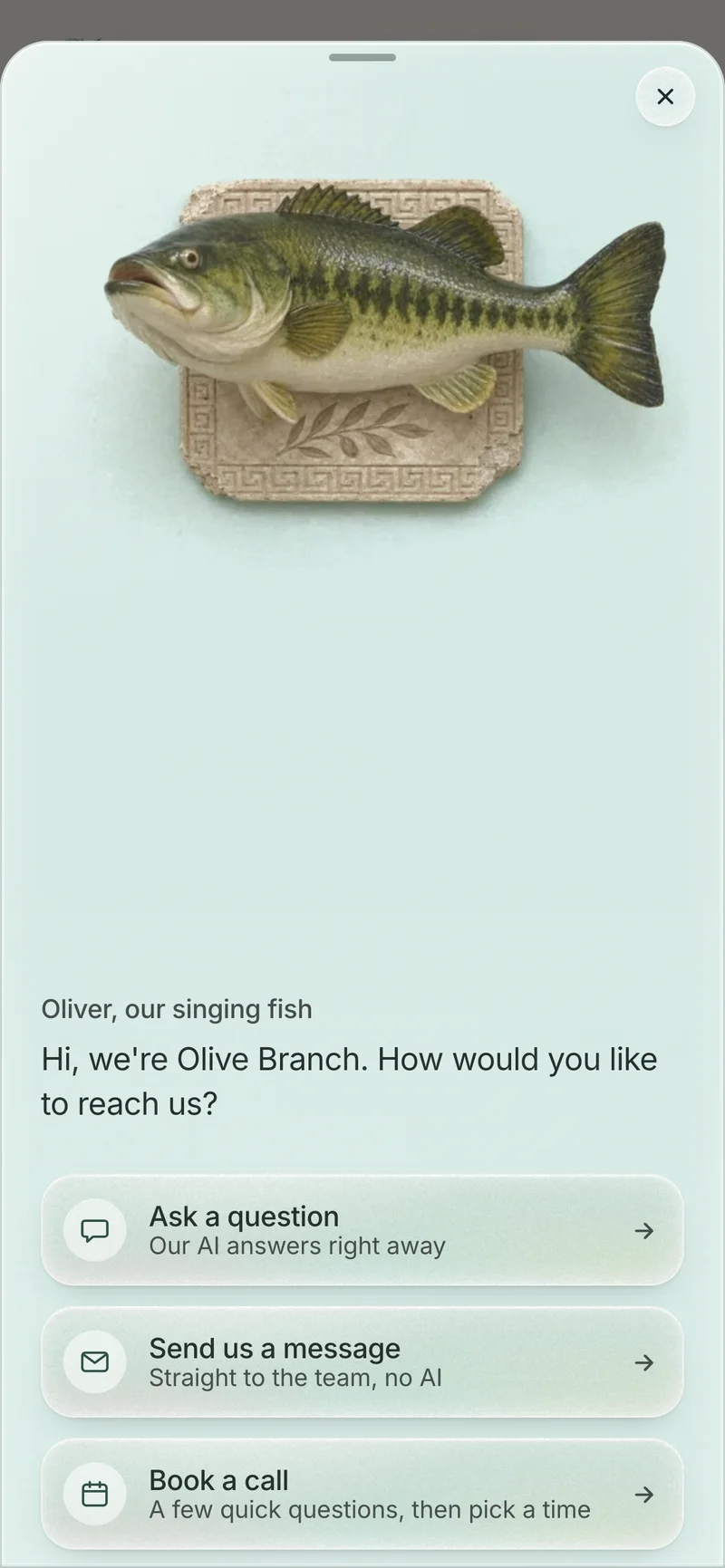
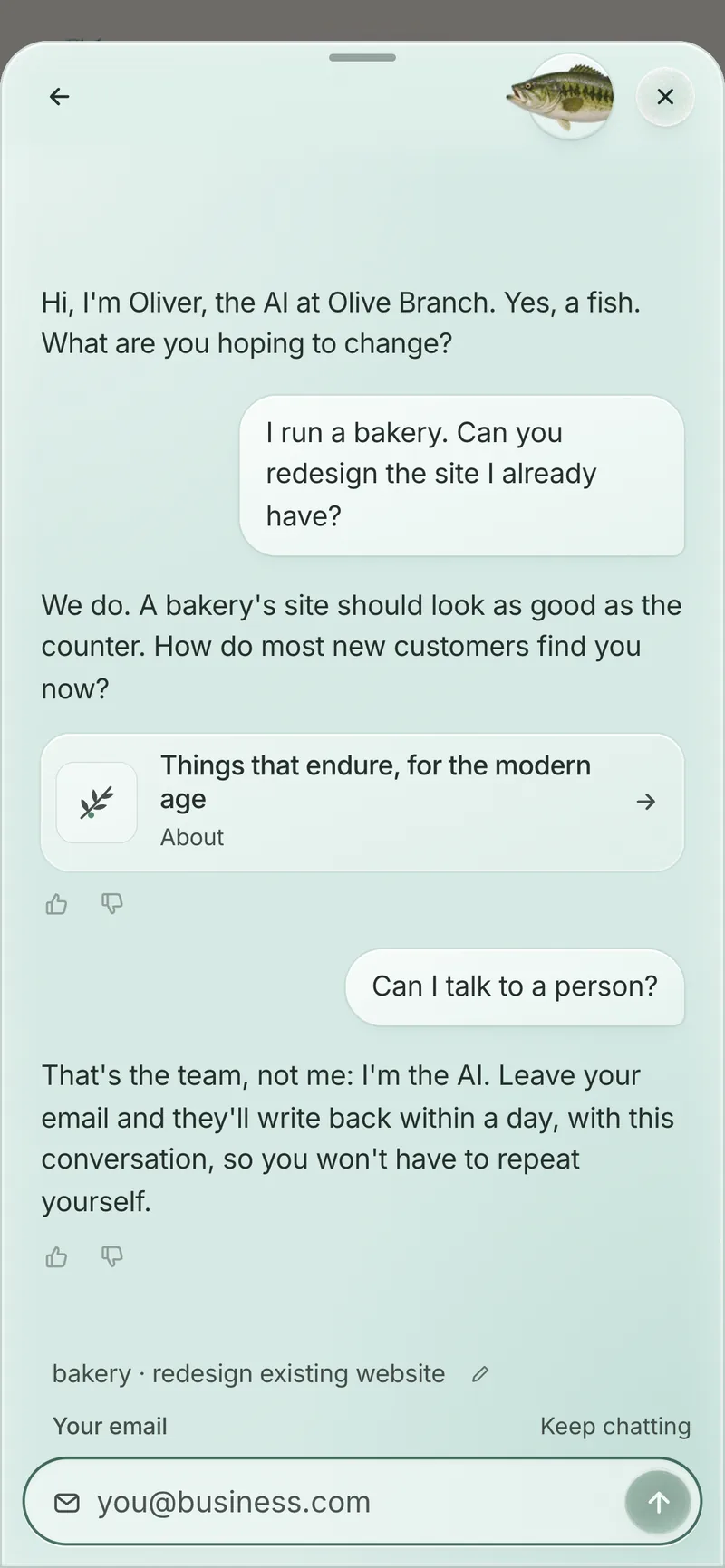
Oliver, the AI assistant on our site, is the hand-off version in practice. He says he’s AI and answers from our own pages. When you want a person, he asks for your email and passes your message and the conversation to the team, who write back within a business day. How we built him has the details.
We design and build websites, apps and custom software, and an assistant like Oliver is one of the things we build for clients. For plenty of businesses, a clear page and a phone button is the better call. Whichever you choose, don’t put up a box that promises somebody who isn’t there.
Where these numbers come from
Prices are copied from each vendor’s own pricing page on 17 November 2026, by the unit each one bills in; we haven’t averaged or converted them. The live chat research comes from online retail and from companies’ contact centers. None of it studies small service businesses, and we’ve said so where it’s used.
- Aircall, “Do Customer Service Wait Time Expectations Vary by Channel?” aircall.io, read 17 November 2026.
- LiveChat, pricing. livechat.com, read 17 November 2026.
- Smith.ai, web chat pricing. smith.ai, read 17 November 2026.
- Intercom, pricing. intercom.com, read 17 November 2026.
- Sun, Chen and Fan, “Effect of Live Chat on Traffic-to-Sales Conversion,” Production and Operations Management, 2021. EconPapers, read 17 November 2026.
- Lehigh Business, “Chatting It Up.” lehigh.edu, read 17 November 2026.
- Castellanos, Yom-Tov and Goldberg, “Silent Abandonment in Contact Centers.” arXiv, read 17 November 2026.
- Gartner, press release, 4 August 2026. gartner.com, read 17 November 2026.