
The short answer
Ask who will actually design and build the site, whether the domain, code and words will be yours in writing, what the price covers and what a change costs, how they’ll keep your search traffic and build for accessibility, and who looks after the site once it’s live. Good answers are specific and end up in the contract. If you only get to ask one, ask about ownership, because a wrong answer there outweighs every right answer elsewhere.
Who will actually design and build it?
The person who sells a project isn’t always the one who makes it. So ask who will design and build yours, and whether you can talk to them. The answer you want is that you’ll deal with those people from the first call on. If you’d only ever speak to a salesperson or an account manager, pause.
Then ask for a walk-through of two projects like yours. A portfolio shows taste; a walk-through shows whether they understood the business. Look for a live site you can open, what the brief was, what they did and what they’d change now. Mockups only, or vagueness about which part was theirs, is a pause.
Ask what happens between the first call and launch, and what they’ll need from you. Every build waits on someone’s words, photos or sign-off, and you want to know when that someone is you. Plain steps and a clear answer on who writes the copy are good signs. “We’ll figure it out as we go” is at least honest.
Last, if clients might one day book or pay in an app, ask whether they can build one, and plan the site with that in mind (more in website or app). A straight yes or no is fine. A yes with no app they’ve designed or built to show you isn’t.
What will you own, and can you take it with you?
Once you know who makes the site, find out who ends up holding it. Paperwork settles that, whoever paid. This is general information about US law, not legal advice; who owns your website covers it in full.
- Whose name will the domain and accounts be in? The domain is the one piece you can’t rebuild, and ICANN, which sets the rules for registrars, advises against listing “website designers, hosting providers, or any other third parties as the registrant(s) of your domain name.”1
A good answer: your business’s name, email and login on the domain, and you as owner or admin on hosting, analytics and your Google Business Profile.
Pause if: “We’ll register it for you,” in their name. - Will you sign over the design, code and words once they’re paid for? Without a signed document, copyright stays with the designer or studio that made the site.* Nor is a commissioned site usually a “work made for hire”: the Copyright Office lists nine kinds of commissioned work that can be, and websites aren’t among them.2
A good answer: yes, in a signed assignment, with anything licensed instead (fonts, photos, a theme) listed.
Pause if: “Of course it’s yours,” and nothing in writing. A handshake is a fine thing, but it doesn’t transfer copyright. - Is it a site builder or custom code, and what happens if we part ways? Either can be right, if you know before you build. Wix says a Wix site “needs to be hosted and operated on Wix’s servers.”3 Squarespace can export only “certain content.”4 Custom code can usually move to another host, but someone has to look after it.
A good answer: the platform, why it suits you, and what you’d take with you, in writing.
Pause if: a platform of their own you can’t leave without a rebuild, mentioned only when you ask.
What does it cost, and what’s in the contract?
Two quotes for “a website” can cover very different work: the number of pages, who writes the copy, photos, forms, moving old content, hosting. So ask what exactly the price includes and what it doesn’t, and expect an itemized list of both. One number for “everything you need” tells you nothing about what you’re getting. (For published prices, see what a website costs.)
Then ask how many rounds of revisions are included and what counts as new work. The line between a tweak and new work is where projects get tense, so draw it before you start: a set number of review rounds, and anything outside the scope priced in writing first. “Unlimited revisions” sounds generous until nobody can agree what a revision is.
Finally, ask to read the contract before you pay, and how either of you gets out. The contract decides ownership, payment and what happens at the end. You want it short, in plain words, sent before any deposit, with notice and a handover described. No exit terms at all is a pause, and so are exit costs you only hear about when you ask.
Will people find it, and can everyone use it?
Both are easiest to get right while the site is being built, and both attract promises worth testing.
- How will you keep the search traffic we already have? Change page addresses without redirects (rules that send an old address to its new page) and old links break. Google’s guide says: “It’s important to map your old site’s URLs to the URLs for the new site.” It says to keep redirects “generally at least 1 year.”5
A good answer: a list of every old address and where it will point, checked after launch.
Pause if: “Google will figure it out.” - What do you promise about rankings? Nothing specific, if they’re honest. Google’s own advice: “No one can guarantee a #1 ranking on Google.”6
A good answer: the basics built in (fast pages, clear titles, a sitemap, pages that answer what clients ask) and a way to measure results.
Pause if: a guaranteed ranking or a page-one promise. - What will you do about AI answers, like ChatGPT or Google’s AI Overviews? Google says: “There are no additional requirements to appear in AI Overviews or AI Mode, nor other special optimizations necessary.”7
A good answer: the same work as good search, with plain answers to what your clients ask.
Pause if: a paid add-on of special AI files, or a promise that AI tools will recommend you. - Which accessibility standard do you build to, and how do you test it? The Justice Department says the ADA covers businesses open to the public, online too, and points to standards such as WCAG for guidance.8 The current version, WCAG 2.2, has three levels: A, AA and AAA.9
A good answer: “WCAG 2.2, level AA,” checked by tool and by hand with a keyboard and a screen reader.
Pause if: a widget that makes you compliant in one line of code. In 2025 the FTC ordered one widget maker to pay $1 million and barred it from claiming, without evidence, that its products “can make any website WCAG-compliant.”10
What happens after launch?
Websites don’t stay done. Updates, backups and security fixes need someone to own them, and hosting, the domain, software and support keep billing. Ask who does each job and what it costs a year: every running cost, and whose account it’s billed to. “It won’t need anything” is the answer to worry about, along with “hosting is included” and no word on what happens if you leave.
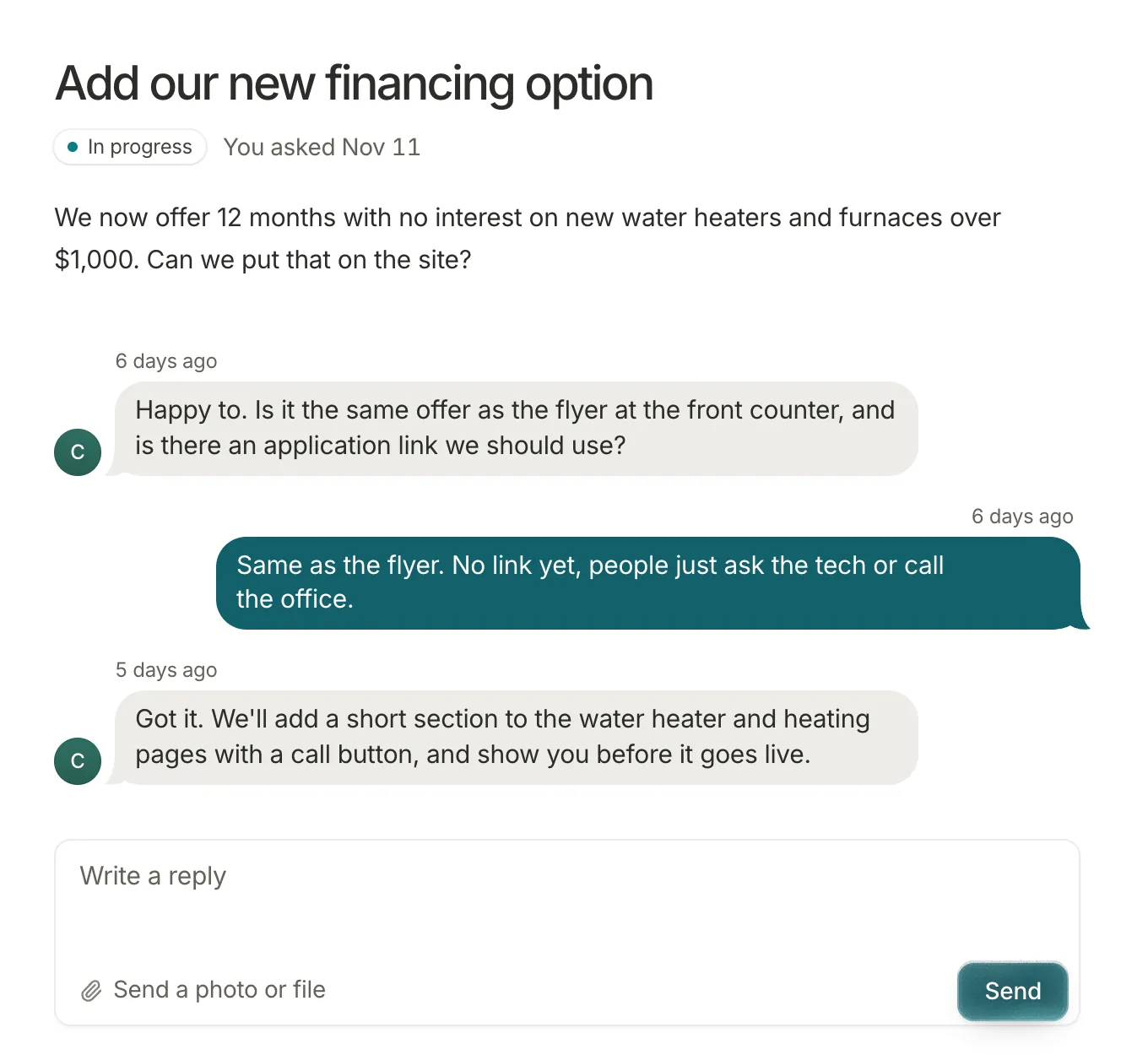
Then ask how changes get made. Your prices, people and services will change, and the site should keep up. A good setup lets you edit simple things yourself or write to the people who built it, and tells you how soon it gets done. Changes that vanish into someone you can’t reach, on no particular schedule, are a pause.
How do you compare the answers?
Ask every designer the same questions, with one page of notes each. Then call two past clients you picked from their portfolio. Google suggests asking an SEO’s past clients whether the service was useful, easy to work with and got results,6 and the same works for designers:
- Did they do what they said, for the price they quoted?
- When something went wrong, what did they do?
- Do you have the logins to your own domain and site?
- How long does a change take now?
- Would you hire them again?
Then score each designer 2, 1 or 0 on every row. Totals help, but we’d let a zero on ownership or the contract outweigh any total.
| What you’re checking | Score 2 if | Score 0 if |
|---|---|---|
| Who does the work | You know who designs and builds it, can reach them, and have seen live work they can explain | You’d never meet the people doing the work, or mockups only |
| Ownership | Domain, accounts and a signed assignment, all yours | Anything stays in their name |
| Price and scope | Itemized, with what’s left out listed | One number for “everything you need” |
| Changes and the contract | Revisions, new work and exit terms in writing | “Unlimited revisions,” or no exit terms |
| Search and accessibility | A redirect map, no ranking promise, WCAG 2.2 AA tested by hand | A guaranteed ranking, or a widget instead of testing |
| After launch | Named upkeep, a clear way to ask for changes, yearly costs listed | “It won’t need anything” |
| References | Two past clients who’d hire them again | None they’ll let you call |
Three answers that end the conversation: the domain or the code stays in their name; they guarantee you a ranking; they won’t put the scope and the ownership in writing. If it can’t go in writing, it wasn’t really an answer.
Questions
Do I need a new website at all?
Maybe not. Run the tests in signs your website needs a redesign first. If the site is sound but quiet, start with getting more leads from the site you already have.
Is it a bad sign if a designer won’t quote on the first call?
Not on its own. A custom build depends on what you need, so some studios want a conversation before they put a number on it. The bad sign is a quote that never arrives itemized. (Ours are published, if you’d like a number before the call.)
Should I ask a designer how they use AI?
Yes. Ask where they use it and who checks the result before you see it. “Never” and “AI does it all” both deserve a follow-up question.
How we answer these
We’d hold ourselves to the same table. The people you talk to are the small team that designs and builds the work. The domain, code and words are yours from the day we start. After launch we look after it for as long as you want us to, and changes go through the client portal every client gets, like the request above. We build apps and custom software too, including our own app, Vigil. And when a template or an agency would serve you better, we tell you.
See our work for Van Peursem Law, and more answers.